Brass is not one metal. It is copper and zinc mixed together, and that mix is what gives brass its strength. Dezincification is what happens when the water pulls the zinc back out. Understand that one sentence and you understand why Kitec fails.
The Chemistry, in Plain Terms
A brass fitting starts life as a solid alloy – copper and zinc locked together, strong enough to hold water pressure for decades. But zinc is reactive. In the wrong water, it slowly dissolves out of the alloy and leaves with the flow.
What is left behind is not solid brass anymore. It is a spongy, porous copper structure. Same shape. Same color, roughly. A fraction of the strength. Under the everyday push of household water pressure, that weakened copper eventually cracks and lets go.
Why the Fitting, Not the Pipe
People ask why the orange and blue pipe holds up while the connections fail. Simple: the pipe is plastic and aluminum, which do not dezincify. Only the brass fittings do. So the Kitec system fails exactly where the brass is – at every joint, elbow, and transition. The strong part of the system connects to the world through its weakest part.
Why Hard Water Makes It Worse
Dezincification is not equally aggressive everywhere. Water chemistry drives the speed, and Las Vegas water is close to worst-case for brass.
Our water is hard, meaning it carries a heavy load of dissolved minerals. That mineral-rich, high-chloride chemistry accelerates the reaction that strips zinc out of brass. Softer water in a wetter climate is far gentler on the same fitting. So a Kitec system that might have lasted 25 or 30 years elsewhere can reach the failure zone here in 15 to 20.
Heat Adds Fuel
Temperature matters too. Chemical reactions run faster when things are hotter, and dezincification is no exception. That is why hot-water lines, the orange side, often show trouble before the cold. And it is part of why Las Vegas is hard on this pipe – long hot seasons keep the water warm, and warm water keeps the zinc leaving.
The Cruel Part: No Warning
The thing that makes dezincification dangerous is not the chemistry. It is the timing.
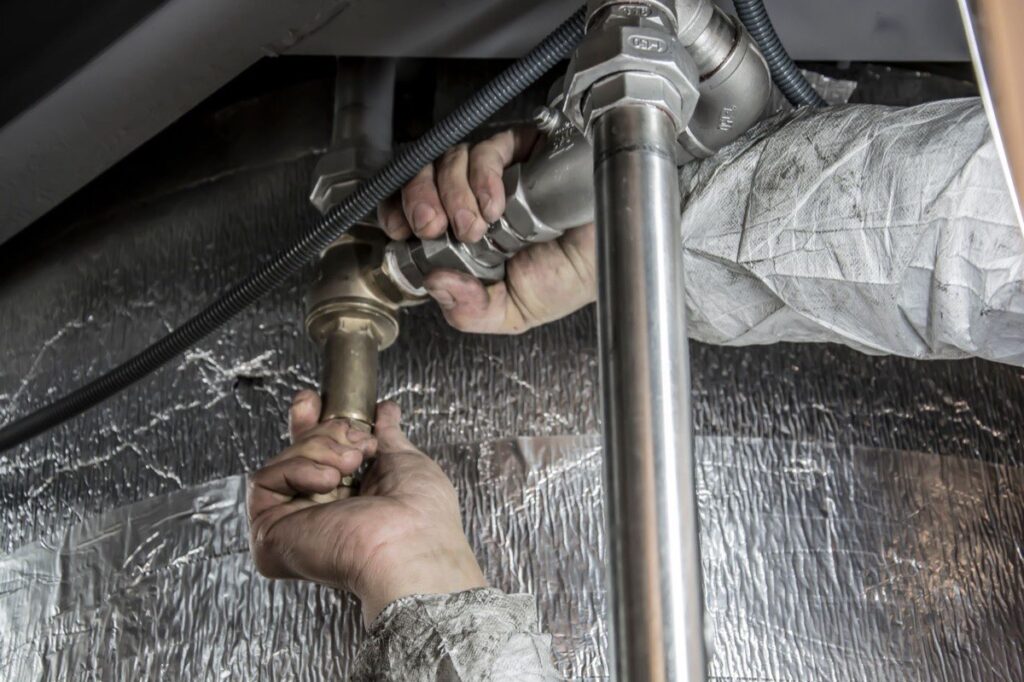
A dezincified fitting can look completely normal right up until it fails. From the outside the brass still looks like brass. There is no drip, no stain, no groan in the pipes to warn you. The damage is happening on the inside of the metal, hidden inside a wall, where nobody can see it. Then one day the porous copper skeleton cracks under normal pressure, and a fitting that “looked fine” the week before is now flooding a ceiling.
That is why you cannot inspect your way to safety by eyeballing a couple of visible fittings and calling it good. The one that fails is usually one you never saw.
Why One Failure Predicts More
Every brass fitting in a Kitec home came from the same era, sat in the same hard water, and ran at the same temperatures. They are all dezincifying on roughly the same schedule. So when the first one lets go, it is not an isolated defect. It is the leading edge. The rest are close behind, which is why the fix is a whole-house repipe and not a single-fitting patch. Patching one leaves you chasing the next.
A Familiar Pattern
Picture a Summerlin home from 2002 where the owner never had a single plumbing issue in twenty years. Then a fitting at an upstairs bathroom fails overnight and soaks the ceiling below. When you cut out that fitting, the brass crumbles like chalk where it should be solid. That is textbook dezincification, and it explains the whole thing at once: no warning, hidden failure, brass that looks fine and is not. It is a scene that plays out across the Valley’s early-2000s homes on a regular basis.
What This Changes for You
Once you understand the mechanism, the Kitec decision gets clearer. This is not corrosion you can slow down with a filter or catch with a visual once-over. The zinc is already leaving, quietly, on a clock set by our water and our heat. The only question left is whether your situation calls for acting now or watching with a plan.
Related Reading
- What Kitec is and why it fails
- Repipe now, or wait? The honest math
- What a whole-house repipe involves
Send us your inspection report – we’ll tell you if that Kitec flag is urgent. Start here.